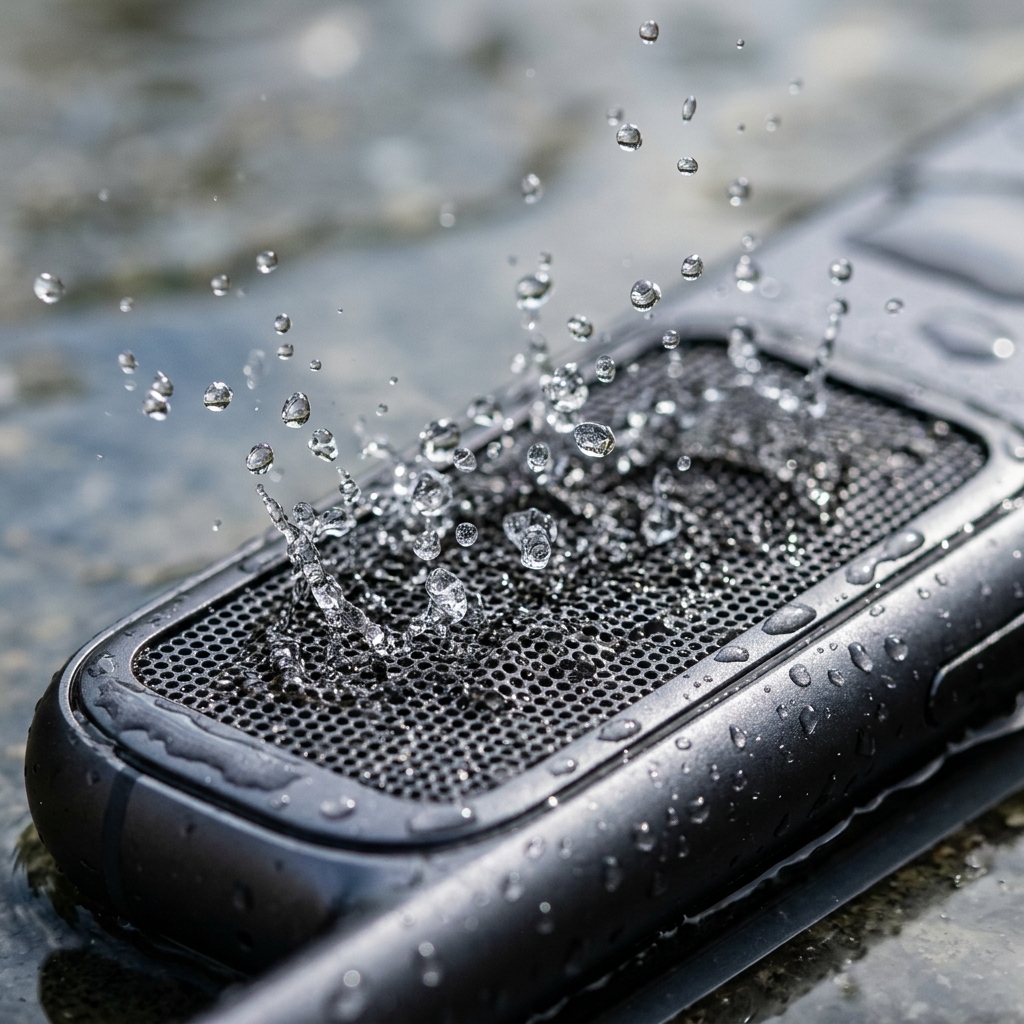
Playing a tone to clean a speaker sounds almost too simple to work. But the technique is rooted in real acoustics, and it's the same principle Apple uses for the Apple Watch's Water Lock feature. Here's what actually happens inside your phone when ClearWave plays its cleaning sweep.
Speakers are pumps as much as they are speakers
A speaker driver is a diaphragm that moves back and forth. When it plays audio it moves quickly to reproduce sound, but when it plays a low-frequency tone it moves in big, slow strokes. Those large excursions push air — and anything sitting in the speaker chamber — outward with real force. In effect, the speaker becomes a tiny pump.
Water trapped in the grille is held there by surface tension. The pressure waves from a low tone overcome that tension and physically eject the droplets. Dust and lint, loosened by the same vibration, work their way out the same path.
Why 165–230 Hz?
Frequency matters. Go too high and the diaphragm barely moves — there's no pumping action. Go too low and you risk over-driving the driver. The 165–230 Hz band is the sweet spot for most phone speakers: low enough to produce large diaphragm excursions, high enough to stay safely within the driver's normal operating range.
ClearWave doesn't play a single fixed tone, though. It sweeps across the range, because every speaker has a slightly different resonant frequency depending on its size and the shape of its chamber. Sweeping ensures the cleaning hits each speaker's most effective frequency instead of guessing one.
Where haptics come in
Sound alone removes most water and loose dust. But compacted debris sometimes needs a mechanical nudge. That's why the Speaker Wizard app pairs the tone with haptic vibration — the phone's vibration motor shakes the whole device at a complementary rhythm, breaking debris free so the pressure waves can carry it out. In our testing this combination removed noticeably more buildup than sound on its own.
Is it safe for the speaker?
Yes. The frequencies and volume are kept within the range your speaker already handles every day playing music and calls. There's no heat, no liquid, and no physical contact with the delicate mesh. The worst case is that a badly corroded speaker doesn't fully recover — but the cleaning itself won't cause harm. For best results, run two or three cycles and keep the speaker pointed downward so gravity helps.
Try the sound cleaner free
Run the 165–230 Hz cleaning sweep in your browser right now, or install Speaker Wizard for haptic-assisted cleaning.